
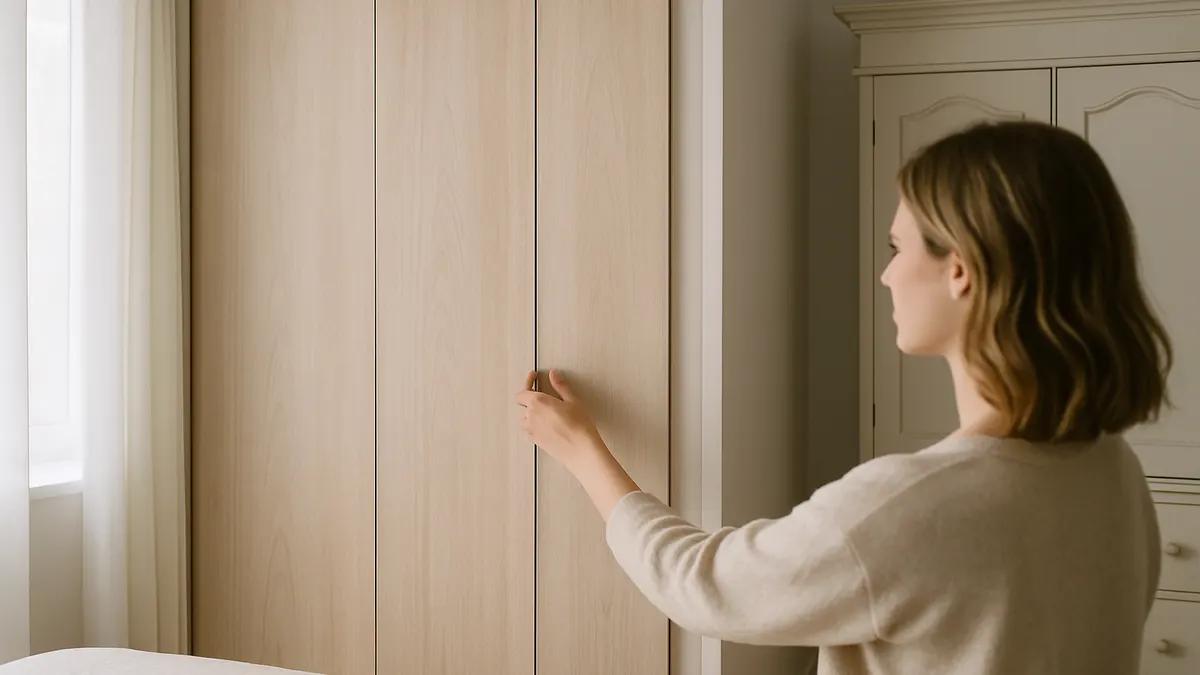
Almost every bedroom storage decision comes down to the same fork in the road: buy a wardrobe, or build one? On the surface the options look interchangeable. The difference shows up two years later, when one is still working the way you hoped and the other has quietly turned into a pile of folded sweaters on the floor.
This guide breaks down the real differences: what each option costs, how much it actually holds, how long it lasts, and which situations genuinely favor one over the other.
Quick Answer: Custom vs Traditional Wardrobe
A traditional wardrobe is standalone furniture built to standard dimensions and placed against a wall. A custom wardrobe is a storage system designed around your specific room — your wall length, your ceiling height, and the clothing you actually own.
Traditional wardrobes cost less upfront, arrive quickly, and move house with you. Custom wardrobes cost more at the start but hold significantly more in the same footprint and use materials that last decades instead of years.
The short rule: renting or moving within two or three years, buy the wardrobe. Staying in the home long term, build one.
What Is a Traditional Wardrobe?
A traditional wardrobe is furniture. It is manufactured to fixed dimensions — commonly 36, 48, or 60 inches wide and 72 to 84 inches tall — and arrives assembled or flat-packed. Inside, you typically get one hanging rod, one or two fixed shelves, and sometimes a drawer at the base.
Where traditional wardrobes make sense
- Rentals and short-term living situations where you cannot modify the walls
- Guest rooms and secondary bedrooms that see light, seasonal use
- Tight budgets where the immediate priority is getting clothes off the floor
- Households that move frequently and want storage that travels
Where traditional wardrobes fall short
The trouble with standard dimensions is that rooms are not standard. Put a 60-inch wardrobe on a 74-inch wall and you have created a gap that will never hold anything useful. Add a nine-foot ceiling above a seven-foot cabinet and you have surrendered two vertical feet of prime storage.
The interior is the second problem. A single rod at a fixed height forces every garment to share the same vertical space, leaving a band of dead air under shorter items. It is the same structural issue behind why generic closet systems fall short for growing families — the layout was designed for an average wardrobe that nobody actually owns.
What Is a Custom Wardrobe?
A custom wardrobe is built to the room rather than dropped into it. The process starts with measurement, moves through a design phase where the interior is planned around your actual clothing inventory, and ends with fabrication and installation. The finished unit runs wall-to-wall and floor-to-ceiling, with no filler panels and no wasted cavities.
What “custom” actually covers
- Interior zoning — double-hang for shirts and trousers, single-hang for dresses and coats, dedicated shoe storage
- Adjustable shelving — shelf positions that move as your needs change, not where a factory drilled them
- Vertical reach — storage that runs to the ceiling, with high shelves for luggage and out-of-season items
- Integrated hardware — soft-close drawers, valet rods, tie and belt racks, built-in hampers
- Finish matching — door styles, hardware, and wood tones chosen to sit with the rest of the room
Homeowners often start by upgrading the interior alone. Replacing a single rod and a wire shelf with properly planned custom closet shelves in Richboro, PA can add usable capacity without touching the walls or doors — a practical first step when a full rebuild is not on the table yet.
Custom Wardrobe vs Traditional Wardrobe: Side-by-Side
Factor | Traditional Wardrobe | Custom Wardrobe |
|---|---|---|
Fit to the room | Standard sizes; gaps at sides and above | Built wall-to-wall and floor-to-ceiling |
Upfront cost | Lower | Higher |
Usable storage | Limited by fixed shelf and rod layout | Typically 25-40% more in the same footprint |
Materials | Often particleboard with laminate finish | Plywood, solid wood, or furniture-grade panels |
Lifespan | Roughly 5-10 years with regular use | Decades; commonly outlives the owner’s tenure |
Flexibility later | Replace the whole unit | Adjust shelves, add drawers, reconfigure sections |
Installation | Self-assembly or delivery | Measured, fabricated, and professionally installed |
Portability | Moves with you | Stays with the home |
Resale appeal | Neutral | A selling feature buyers notice |
Cost: What You Pay Now vs What You Pay Over Time
Sticker price is where traditional wardrobes win, and it is not close. A flat-pack unit runs a few hundred dollars; a mid-range retail wardrobe might reach a thousand. Custom builds typically start in the low thousands and climb with size, material, and hardware.
The picture changes at cost per year of service. A particleboard wardrobe under a full clothing load tends to sag at the shelves and loosen at the joints between year five and year ten. Replace it twice and you have spent close to what a custom unit would have cost, while living with compromised storage the whole time.
Storage Capacity: The Difference Nobody Measures
Take the same eight feet of bedroom wall. A traditional wardrobe gives you roughly one rod’s worth of hanging space plus a shelf above. A custom build across that same wall can deliver two levels of hanging, a bank of drawers, angled shoe shelving, and a full-width top shelf for seasonal storage.
The gain comes from three places: eliminating side gaps, using the space between cabinet top and ceiling, and splitting the interior into zones sized for what actually hangs there. Together these routinely produce 25 to 40 percent more usable capacity in an identical footprint.
Families feel this most acutely in shared bedrooms and children’s rooms, where one rod has to serve two people and four seasons. Purpose-built custom made closets in Richboro, PA solve it by giving each person a defined zone instead of asking them to negotiate over a single crowded rail.
Materials and Durability
Most traditional wardrobes use particleboard or MDF with a laminate surface. Both are serviceable under light loads, but neither handles weight well over long spans. A 30-inch shelf carrying folded denim will bow within a couple of years, and once particleboard absorbs moisture the swelling is permanent.
Custom builds generally use furniture-grade plywood, solid hardwood, or thicker engineered panels with proper edge banding, supported at shorter intervals. The result holds weight without deflection and takes years of daily use without the hardware working loose.
Material choice also shapes how the room feels. Warm grain and visible timber give a bedroom a built-in, architectural quality that painted board cannot replicate, which is why wood closet shelving remains the most requested finish for primary bedrooms.
If you are still weighing manufactured options against a fully bespoke build, it is worth reading how custom systems compare with prefab closet kits, since prefab sits in the middle ground between the two approaches discussed here.
Design, Style, and Home Value
A freestanding wardrobe always reads as furniture, which can be exactly right in a period property or a room you like rearranging. It also means visible gaps and a fixed silhouette that competes with the architecture rather than joining it.
A custom wardrobe becomes part of the room. Panel lines align with door casings, the top meets crown molding cleanly, and lighting can be integrated behind the fascia. Buyers register this immediately during a walkthrough.
Two related decisions are worth planning at the same time: sliding versus hinged wardrobe doors, which determines how much floor clearance you need in front of the unit, and standard wardrobe dimensions and depth requirements, which decides whether garments hang square or press against the back panel.
How to Decide: A Five-Step Process
- Measure the wall properly. Record width at floor and at ceiling height, and note every obstruction — baseboards, outlets, vents, trim. Walls are rarely square, and that variance decides what a standard unit can achieve.
- Inventory what you own. Count hanging garments, folded items, shoes, and bulky seasonal pieces separately. A mostly-folded wardrobe needs a very different interior than a mostly-hanging one.
- Set your time horizon. Under three years in the home, buy furniture. Over five years, build. In between, weigh how much the current storage frustrates you daily.
- Compare on cost per year, not sticker price. Divide each option by its realistic service life. The gap narrows sharply.
- Decide what happens when you leave. Furniture goes with you; a built-in stays with the sale. Neither is wrong, but the choice should be deliberate.
Which Option Is Right for You?
Choose a traditional wardrobe if
- You are renting, or expect to move within two to three years
- The room is secondary and sees occasional use
- You need a solution in days rather than weeks
- Your budget is fixed and immediate
Choose a custom wardrobe if
- You own the home and intend to stay past five years
- The current storage is full and clothing is spilling elsewhere
- Your room has awkward dimensions, high ceilings, or an alcove
- The space is shared and needs defined zones for more than one person
The Best Closet for Your Lifestyle
There is no universal answer here, only the right one for your room, your timeline, and the clothes you own. A traditional wardrobe wins when flexibility and speed matter more than fit. A custom wardrobe wins when you want every inch of the wall working and plan to stay long enough to enjoy it.
If you are ready to see what your space could actually hold, the team at Closets Creation Inc can measure your room and show you a layout built around your real storage needs before you commit to anything.
Frequently Asked Questions
Is a custom wardrobe worth the extra cost?
For homeowners staying more than five years, generally yes. Custom units hold 25 to 40 percent more in the same footprint and use materials that last decades rather than years. For short-term living, the higher upfront cost is harder to justify.
How much more storage does a custom wardrobe actually provide?
In an identical footprint, expect 25 to 40 percent more usable capacity — gained by removing side gaps, using the space between cabinet top and ceiling, and zoning the interior around what you actually hang and fold.
How long does a custom wardrobe take to install?
Most projects run three to six weeks end to end: about a week for design and measurement, two to four weeks for fabrication, and one or two days on site for installation.
Do custom wardrobes increase home value?
They rarely return a precise dollar figure, but built-in storage improves how a bedroom shows. Buyers read a well-built wardrobe as usable space rather than furniture to work around.
Can I customize the inside of a wardrobe I already own?
Often, yes. Adding adjustable shelving, a second hanging rod, drawer inserts, or shoe racks improves capacity at a fraction of the cost of a rebuild — a common interim step before a full project.
Will a custom wardrobe work in a small bedroom?
Small rooms often benefit most. When floor space is scarce, using full ceiling height and eliminating side gaps recovers storage a standard cabinet cannot reach.