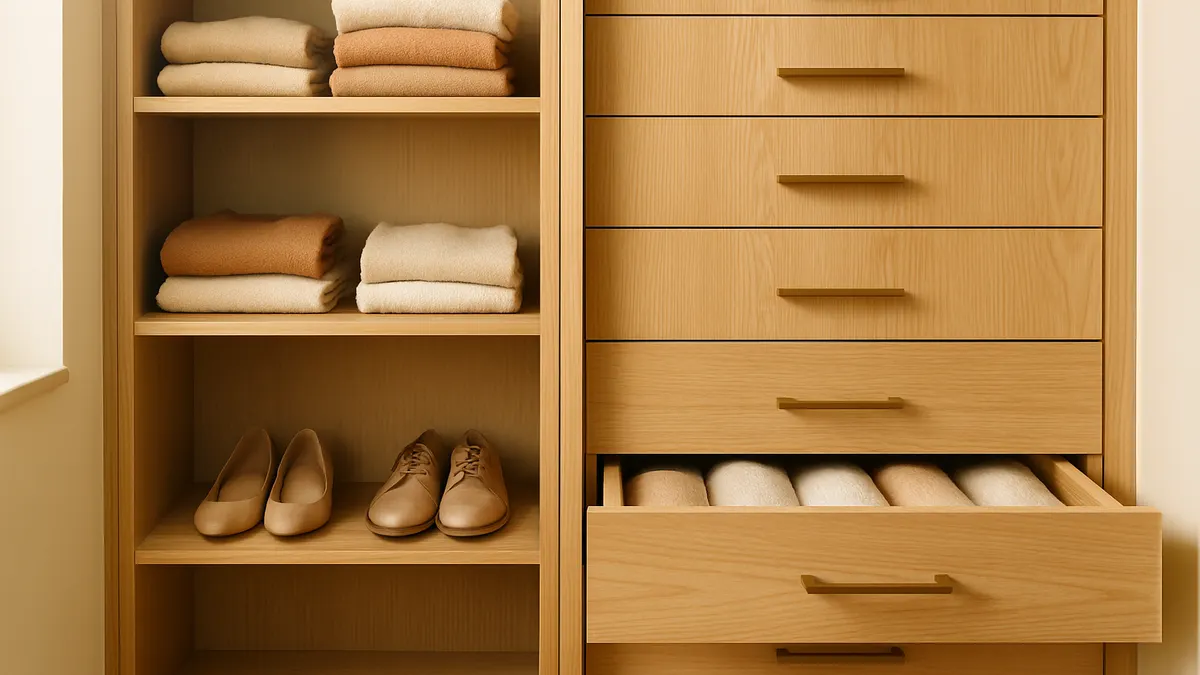
Open shelving is best for items you want to see and reach quickly, while drawers are better for smaller or personal items you prefer to keep tucked away. For most custom closets, a combination of open shelving and drawers offers a good balance of visibility, organization, and easy access.
When planning a custom closet, the choice between open shelving and drawers can affect how easily you find your belongings and keep the space organized. The right option depends on what you store, how often you use it, and whether you prefer items to stay visible or neatly concealed.
Open Shelving vs Drawers: What’s the Difference?
Open shelving and drawers solve the same problem, keeping your things organized, but they take opposite approaches.
Open Shelving
With open shelving, everything stays visible. You can see your folded sweaters, stacked shoes, or storage bins the moment you walk in, which makes it easy to grab what you need without digging around. Open shelves work well for folded clothing, shoes, bags, and bins, and they’re especially useful when you want to see everything you own at a glance.
Drawers
Drawers close things off. What’s inside stays out of view, which gives the closet a cleaner look. They’re a natural fit for smaller items like socks, underwear, jewelry, and accessories that tend to look messy sitting out in the open. Because everything is enclosed, drawers also help cut down on visible clutter.
Benefits of Open Shelving in a Custom Closet
1. Everything Is Easy to See
When your clothes and accessories are out in the open, you’re not digging through drawers or moving bins to find what you need. You can see your whole collection at a glance, which saves time every morning.
2. Easy Everyday Access
Open shelves are ideal for clothes you reach for often. Folded shirts, sweaters, and jeans you wear every week don’t need to be tucked away; having them within arm’s reach makes getting dressed faster.
3. Flexible Storage
Shelves can hold items of very different shapes and sizes, from bulky sweaters to small folded stacks, as long as the spacing is planned around what you actually own.
4. Good for Shoes and Bags
Shoes and handbags are easier to choose from when they’re displayed rather than stacked inside a closed space. You can see colors and styles right away instead of guessing what’s in each box.
5. Creates an Open Feel
A closet built mostly around open storage tends to feel lighter and less boxed in than one filled with solid cabinetry, especially in a smaller room.
Benefits of Drawers in a Custom Closet
1. Keeps Small Items Contained
Socks, underwear, belts, and small accessories get messy fast on an open shelf. Drawers keep them contained and easy to find instead of turning into a pile.
2. Reduces Visual Clutter
Closing a drawer instantly hides whatever’s inside. If you’d rather not see every small item each time you open the closet, drawers handle that well.
3. Better for Personal Items
Some belongings, like jewelry or personal accessories, are things people prefer to keep out of view. Drawers give those items a private spot.
4. Easier Sorting
Multiple drawers let you assign categories, one for socks, one for accessories, one for belts, so everything has its own place instead of getting mixed together.
5. Adds a More Finished Look
Drawer fronts give a custom closet a built-in, furniture-like appearance that open shelving alone doesn’t provide.
Open Shelving vs Drawers: Side-by-Side Comparison
Feature | Open Shelving | Drawers |
Visibility | Excellent | Low |
Quick access | Excellent | Very good |
Small items | Fair | Excellent |
Folded clothing | Excellent | Good |
Shoes | Excellent | Limited |
Privacy | Low | High |
Visual clutter | More visible | Less visible |
Space efficiency | Very good | Depends on drawer depth |
Best for | Items used often | Smaller personal items |
Which Is Better for Different Closet Items?
Instead of asking which storage type wins overall, it helps to look at where each one actually works best.
Best for Open Shelving
- Sweaters
- Jeans
- Handbags
- Shoes
- Folded towels
- Storage baskets
- Frequently used accessories
Best for Drawers
- Socks
- Underwear
- Jewelry
- Belts
- Small accessories
- Personal items
- Items that look messy when left out
The takeaway is simple: choose storage based on the item itself, not just on how you want the closet to look. A drawer full of sweaters wastes space, and an open shelf covered in loose socks looks cluttered no matter how it’s arranged.
When Should You Choose Open Shelving?
Open shelving tends to make the most sense when:
- You want to see most of your belongings at a glance
- You reach for folded clothing often
- You own a lot of shoes or handbags
- You want the fastest possible access
- You’re trying to get the most out of visible storage space
- Quick access matters more to you than keeping things hidden
If speed and visibility matter more than tucking things away, shelving is usually the better fit.
When Should You Choose Drawers?
Drawers make more sense when:
- You have a lot of small items that need to stay contained
- You want a calmer, less busy-looking closet
- Certain belongings need to stay out of view
- You need dedicated space for accessories
- You’re sharing the closet and want categories kept separate
- Loose items sitting on open shelves bother you
If a cleaner, more private look matters more than instant visibility, drawers are the better call.
Should a Custom Closet Have Both Shelves and Drawers?
For most people, the answer is yes. A closet built entirely around one storage type usually ends up working against how people actually get dressed.
A practical layout might look like this:
- Hanging space for shirts and dresses
- Open shelves for folded sweaters and jeans
- Drawers for underwear and accessories
- Open shoe storage near the floor
- Higher shelves for items used less often, like seasonal clothing
The advantage of a custom closet is that it doesn’t force every item into the same type of storage. It can be planned around what you actually own and how you use it, so the layout works with your habits instead of against them. Starting with solid closet planning before locking in specific storage choices makes that kind of layout much easier to get right.
What About Cost?
The cost of a custom closet depends on more than just whether you choose shelves or drawers. Closet size, the number of shelves and drawers, materials, hardware, finish, installation, and any custom design work all play a role.
Open shelving tends to be a simpler build, while drawers add extra hardware and construction, which can add to the overall cost. That doesn’t mean drawers aren’t worth it, it just means the decision should come down to what your storage actually needs, not which option costs less. A well-planned mix of both, matched to your own shelving ideas and daily habits, usually pays off more than picking whichever option is cheaper.
How to Decide Between Open Shelving and Drawers
A few quick questions can help:
- Do you want to see your belongings? Lean toward open shelving.
- Do you have a lot of small items? Add drawers.
- Do you want certain items hidden? Choose drawers.
- Do you own a lot of shoes or handbags? Open shelving may work better.
- Do you want the most flexible setup? Combine both.
Final Verdict: Open Shelving or Drawers?
Open shelving is the better choice for visibility, quick access, shoes, bags, and the folded clothing you reach for every day. Drawers are better for smaller, personal, or easily scattered items that look messy when left out.
For most custom closets though, the best answer isn’t picking one over the other. It’s building a layout where each type of storage has a clear job to do.
If you’re planning a custom closet, the right mix of shelves, drawers, hanging space, and other storage features can make a real difference in how the space works every day. A custom design can be built around your wardrobe, your available space, and your storage habits.
If you’d like to see what that could look like for your own closet, you can explore custom closet solutions built around exactly how you live.
Closets Creation designs and installs custom closet systems for homeowners throughout Doylestown, Richboro, Holland, Warminster, and Newtown.
Frequently Asked Questions
Can I mix open shelving and drawers in the same closet section?
Yes. Many custom closets combine both within a single section, for example drawers below and open shelves above, so frequently used items stay visible while smaller belongings stay contained in the same footprint.
Do drawers make a closet harder to clean?
Not really. Drawers are actually easier to keep tidy since dust and clutter stay contained inside rather than settling on an open surface that needs regular wiping and straightening.
Are open shelves a good option for a shared closet?
They can be, but shared closets often benefit more from drawers since they let each person have a clearly separated space for personal items without things getting mixed together on open shelves.
How deep should closet drawers be for clothing storage?
Drawer depth depends on what is being stored. Shallower drawers work well for accessories and folded small items, while deeper drawers suit bulkier clothing. A closet designer can size drawers around your specific wardrobe.
Will too many open shelves make a closet look cluttered?
It can, if the shelves are not planned with enough space for what you own. Well-spaced shelving that matches the size and volume of your items usually stays organized rather than crowded.
Is it more expensive to add drawers instead of just using shelves?
Usually yes, since drawers involve more hardware and construction. But the added cost often pays off for anyone who needs contained storage for smaller items that do not work well on open shelves.