
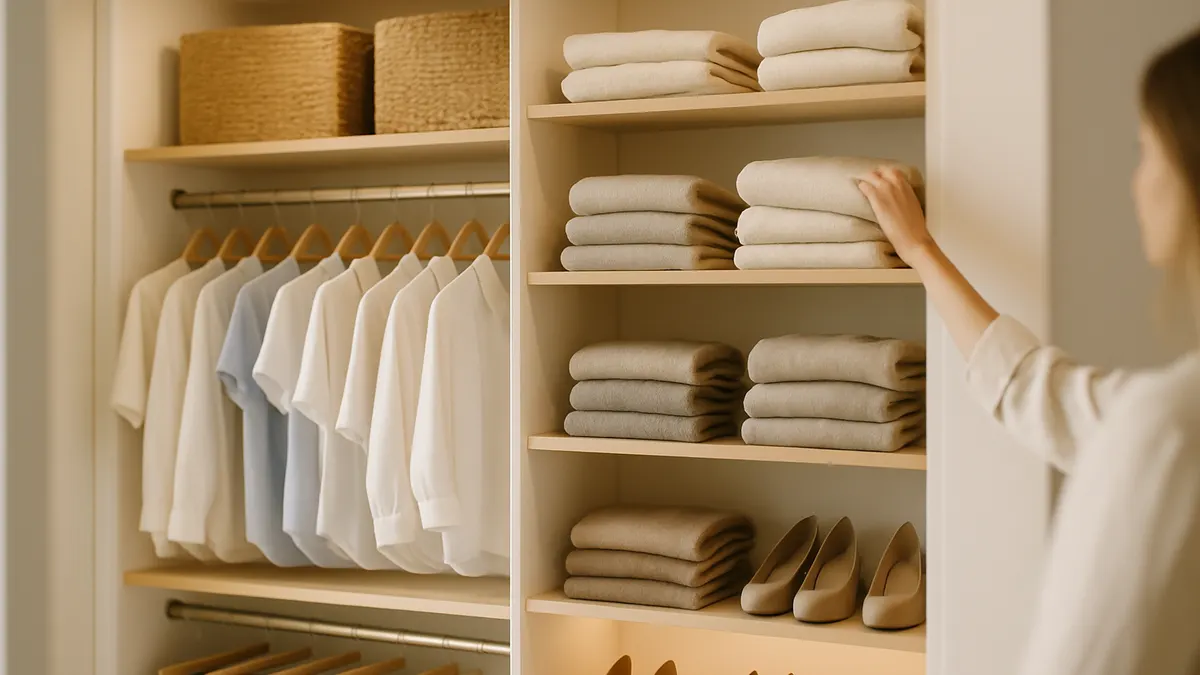
Closet dimensions decide how well a closet works every day. A shelf that is too deep hides things in the back. A rod set too high makes every shirt a reach. Shelves spaced too close leave no room for sweaters, and shelves spaced too far apart waste vertical space.
Many homeowners start with standard closet dimensions, and that is a smart move. Still, no single measurement fits every closet. Your clothes, your habits, and your wall space all change the answer. This guide covers common numbers for shelf depth, rod height, and spacing, plus how to adjust them.
What Are Standard Closet Dimensions?
Standard closet measurements are the common numbers closet designers use as a starting point. They cover closet width and depth, shelf depth, hanging rod height, shelf spacing, and the storage above the rod. These are guidelines, not strict rules.
Why Measurements Matter Before Installing Storage
Wrong numbers show up fast. You may end up with:
- Cramped clothes
- Shelves that are hard to reach
- Wasted vertical space
- Rods set too high or too low
- Bins and organizers that do not fit
Standard Closet Shelf Depth
Most closet shelves are 12 inches (1 foot) deep. That fits folded clothes, shoes, and most bags. Shelves up to 16 inches (1.3 feet) suit bulky bins.
Deeper is not always better. Items slide to the back and get forgotten. Shelves under 10 inches limit what you can store.
Choosing Shelf Depth Based on What You Store
What You Store | General Depth |
|---|---|
Sweaters and folded shirts | 12 to 14 in |
Shoes | 12 in |
Handbags | 12 to 14 in |
Storage bins and baskets | 14 to 16 in |
Seasonal clothing | 12 to 16 in |
Sweaters and folded shirts stay easy to see on a 12 inch shelf. Pick bin shelves only after you measure the bins.
Standard Closet Rod Height
Rod height affects how easily you reach your clothes. A single hanging rod usually sits 66 inches (5.5 feet) from the floor. That works for a mix of shirts, pants, and shorter dresses. The rod should sit about 12 inches from the back wall in a 24 inch deep closet.
Match the rod to the clothing. Short hanging clothes, like shirts and folded pants, need about 36 to 42 inches of space. Long hanging clothes, like dresses and coats, need 60 to 70 inches. Kids closets often work well with a rod at 40 to 48 inches, so children can reach it.
Single Rod vs. Double Rod Height
A double hanging rod uses vertical space better. Set the upper rod near 80 inches (6.7 feet) and the lower rod near 40 inches (3.3 feet). Use both for shirts, blouses, and folded pants. Keep dresses, long coats, and long suits on a single rod. Adding a second rod is one of the simplest ways to try vertical closet organization in a small space.
How Much Space Should Be Between Closet Shelves?
Match shelf spacing to what you store. Too little space makes stacks tumble. Too much leaves empty air. Adjustable closet shelves help because you can move them as your needs change.
Storage Item | Suggested Shelf Spacing |
|---|---|
Folded shirts | 10 to 12 in |
Sweaters | 12 to 14 in |
Shoes | 8 to 10 in |
Bins | 12 to 16 in |
Handbags | 12 to 14 in |
These are general guidelines. Boots and tall items need more room.
Standard Closet Dimensions for Different Closet Types
Reach-In Closet Dimensions
A reach-in closet is usually 24 inches (2 feet) deep and 3 to 8 feet wide. Leave room for doors to open. About 24 inches in front of sliding doors and 36 inches for swing doors is a good guide. Once the numbers are set, reach-in closet organization gets much easier.
Walk-In Closet Dimensions
A walk-in closet starts around 5 by 5 feet. Plan a walkway of 30 to 36 inches. Storage on both sides needs a width near 7 feet. Keep hanging space 24 inches deep and shelves 12 to 16 inches deep. Going deeper only creates hard to reach corners.
Small or Narrow Closet Dimensions
Narrow closets gain the most from double rods, shelves of 10 to 12 inches, and adjustable parts. Group items by zone, with daily wear near the front and seasonal items up high.
Standard Closet Dimensions Cheat Sheet
Use this table for quick reference. All numbers are general ranges.
Closet Feature | Common Measurement Range | Best Use |
|---|---|---|
Shelf depth | 12 to 16 in (1 to 1.3 ft) | Folded clothes, shoes, bins |
Single rod height | 66 in (5.5 ft) | Mixed clothing |
Double rod height | 40 in and 80 in | Shirts, pants, blouses |
Shelf spacing | 8 to 16 in | Varies by item |
Long hanging clearance | 60 to 70 in | Dresses and coats |
Upper storage | 80 to 84 in high | Seasonal or rarely used items |
How to Measure Your Closet Before Adding Shelves or Rods
Measure first, then buy or install. Follow these steps:
- Measure the total closet width.
- Measure floor to ceiling height.
- Measure the available depth.
- Mark where existing shelves and rods sit.
- Check door swing and clearance.
- Measure the clothes and items you plan to store.
- Plan each storage zone before buying materials.
Measure in a few spots, since walls are rarely square, and use the smallest number. Writing everything down makes custom closet planning much simpler.
Common Closet Dimension Mistakes to Avoid
- Making shelves too deep
- Installing the rod too high
- Leaving empty space above shelves
- Spacing shelves too tightly
- Forgetting long garments
- Ignoring door clearance
- Using fixed numbers without checking real storage needs
- Overlooking vertical space
When Standard Closet Dimensions May Not Be Enough
Standard numbers are a starting point. Sloped ceilings, unusual shapes, narrow closets, shared closets, large wardrobes, growing kids, and special shoe or accessory storage often need something different. A custom closet system can change shelf depth, rod height, storage zones, and vertical space to match your actual needs.
Measure Smart, Store Better
There is no perfect closet measurement for everyone. Match shelf depth to what you store, rod height to your clothing, and shelf spacing to what you reach for. Do not waste vertical space, and always measure the real closet first.
If you want help turning these numbers into a plan, Closets Creation can design a custom storage system around your space. We serve Richboro, Newtown, Southampton, Warminster, Holland, and nearby Bucks County areas. Reach out any time to talk through your closet.
Frequently Asked Questions About Standard Closet Dimensions
What is the standard depth for a closet shelf?
Most closet shelves are 12 inches deep. Bins may need up to 16 inches, while shoes fit well on 12 inch shelves. Match the depth to what you store.
How high should a closet rod be?
A single rod is usually set around 66 inches (5.5 feet) from the floor. The right height depends on your clothing type and whether you use one or two hanging levels.
How much space should be between closet shelves?
Shelf spacing should match the height of what you store. Folded shirts need about 10 to 12 inches, and shoes need about 8 to 10 inches. Adjustable shelves give you the most flexibility.
What is the standard depth of a reach-in closet?
A reach-in closet is typically 24 inches deep. Door style and wall construction can reduce usable depth, so measure inside the closet.
How high should a double closet rod be?
Think in two hanging zones. The upper rod is often near 80 inches and the lower rod near 40 inches, which suits shorter clothes. Adjust both for your clothing lengths.
Are standard closet dimensions the same for every closet?
No. Wardrobe size, closet type, ceiling height, accessibility needs, and storage habits all change the ideal layout. Standard numbers are only a starting point.